richard serra
Richard Serra (1938, San Francisco, California – 2024, Orient, New York) American artist whose work redefined sculpture through a sustained investigation of material, process, and spatial experience. He is widely regarded as a central figure in post-Minimal and Process Art and one of the most significant artists of his generation.
Serra studied English literature at the University of California, Santa Barbara (BA, 1961), before undertaking graduate study in fine art at Yale University (MFA, 1964). At Yale, he studied under Josef Albers and was part of a generation that included Chuck Close and Brice Marden. In the late 1960s, Serra emerged in New York with a body of work grounded in process and action. His “Verb List” (1967–68) articulated a series of operations—such as to roll, to fold, to cut, and to cast—that established a procedural foundation for his practice. Early works employed industrial materials including rubber, neon, and lead, foregrounding weight, gravity, balance, and the physical behaviour of matter. From the early 1970s onward, Serra developed his large-scale sculptures in weathering steel. Composed of massive, curved plates, these works are conceived not as discrete objects but as structures that define and transform space. Their scale and configuration require bodily engagement: the viewer moves through and around them, encountering shifting perspectives, changing orientations, and unstable spatial relationships.
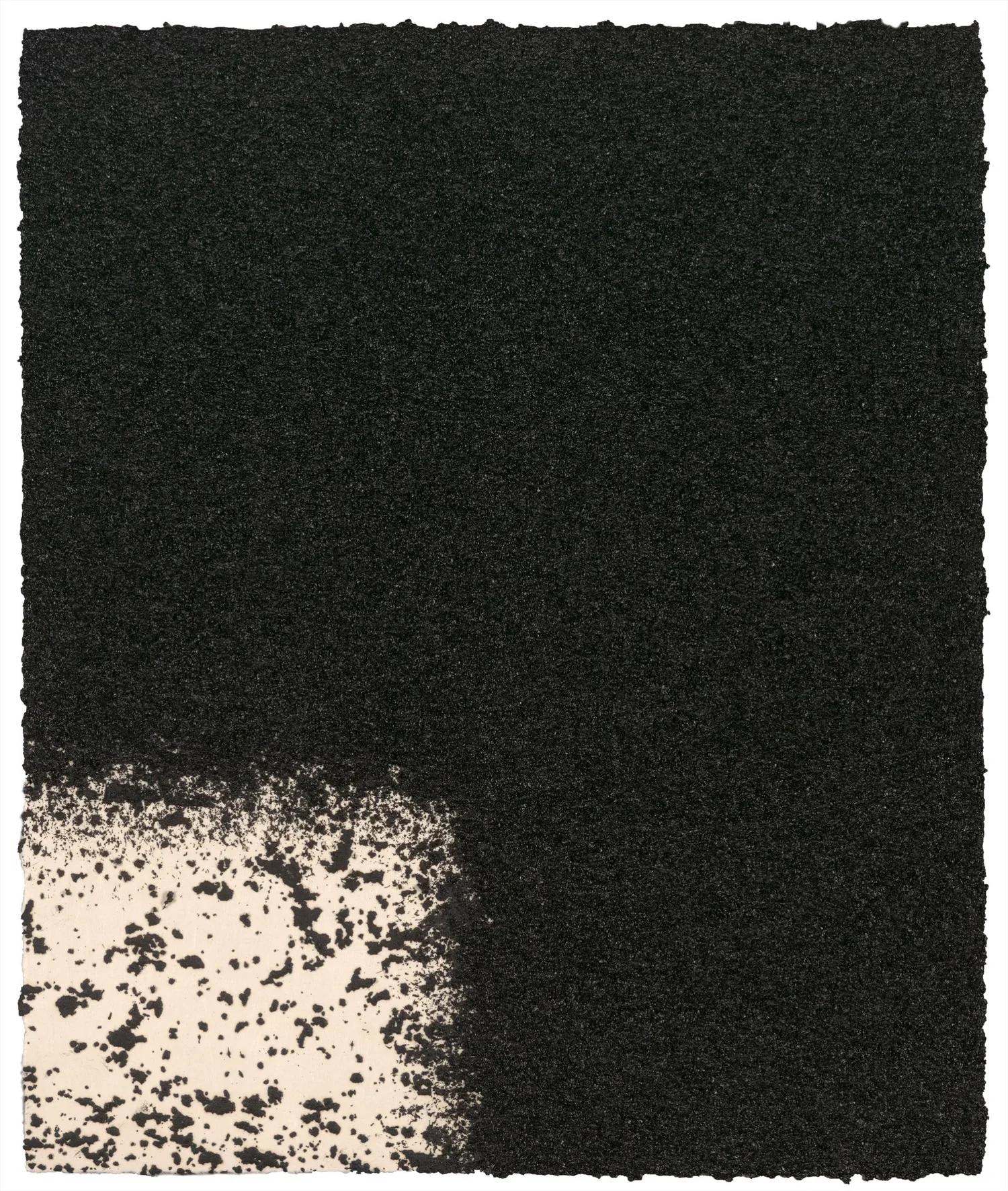
Parallel to his sculpture, Serra maintained an extensive drawing practice. His large-scale drawings, often executed with paintstick on paper or linen, emphasise density, weight, and surface, extending the concerns of his sculptural work into two dimensions. Serra’s work has been the subject of major institutional exhibitions internationally, including retrospectives at the Museum of Modern Art, the Solomon R. Guggenheim Museum, and Dia:Beacon, where a permanent installation of his work is held. His sculptures are included in major public and museum collections worldwide.
Serra’s practice is defined by a consistent refusal of representation in favour of an engagement with the physical and temporal conditions of sculpture. Through scale, mass, and material, his work establishes a direct relationship between object, site, and viewer, fundamentally altering the experience of space.
In his later works, Serra employed oil stick—a dense compound of pigment, linseed oil, and wax—applied directly to handmade paper. Rather than drawing, he built the surface through repeated, forceful gestures, pressing and working the material into the paper by hand. The process was cumulative and time-intensive, with each layer requiring extended periods to dry before the next could be added.
Through this method of accretion, Serra transformed printmaking into a process of construction. The resulting works possess a palpable mass and depth, asserting themselves less as images than as physical entities shaped by pressure, duration, and material presence.
Please contact the gallery at gallery@richeldisfineart.com for available works on paper and editions.