ESPAÑOL
Richeldis Fine Art BCN presenta una exposición del artista británico Jonathan Callan y la artista sueca Sophie Tottie. Tottie y Callan convergen en el punto donde la información pierde su certeza y se transforma en forma visual y material.
A través del dibujo, la pintura, la escultura y la intervención material, ambos artistas exploran cómo los sistemas de significado se transforman a través de la forma material. Durante más de tres décadas, Jonathan Callan (n. 1961, Mánchester) ha desarrollado una práctica centrada en la vida física de la información y en los diferentes lenguajes mediante los cuales organizamos y comprendemos la experiencia. Al trabajar con libros, mapas, partituras musicales, fotografías y otros materiales impresos, aborda estos objetos no solo como portadores de significado, sino como elementos dotados de peso, estructura y resistencia propios. Los libros y las páginas se cortan, se intervienen con dibujo, se superponen, se entierran, se comprimen o se incrustan en yeso, silicona y resina. Callan ha descrito su relación con los libros como la de un alfarero con la arcilla: un material que se manipula, se pone a prueba y se transforma. Como él mismo escribe: «El modo en que reducimos nuestras experiencias del mundo a diferentes lenguajes desempeña un papel de enorme relevancia en la manera en que luego lo entendemos».
Sus intervenciones perturban la expectativa de que la información impresa deba permanecer estable o que el tratamiento de un texto por parte de un artista deba ilustrar necesariamente su contenido. En su lugar, las palabras pueden convertirse en imagen, las páginas en estratos y los sistemas habituales de comunicación en algo extraño o recién visibilizado.
Esta exposición reúne catorce obras que abarcan más de dos décadas, desde 2004 hasta piezas creadas en 2026. A lo largo de este periodo, los métodos y materiales de Callan cambian continuamente mientras persiste la indagación subyacente. El material impreso se dibuja por encima, se corta, se combina, se oculta o se incrusta; el yeso, la silicona y la resina introducen distintas condiciones físicas. Las obras individuales pueden parecer marcadamente diferentes entre sí y, sin embargo, permanecen conectadas por interrogantes sobre cómo se construye, se comunica y se comprende la información.
La notación musical constituye un hilo conductor a lo largo de la exposición. La atracción de Callan por ella comenzó mucho antes de que su audición se deteriorara y, según explica, surgió del mismo interés que lo atrajo hacia los libros, los mapas y otros modos de información. En Gigue, relative too (2004), un punto se aísla en la página y cada nota es atraída hacia él, creando lo que Callan describe como una nueva perspectiva tanto visual como musical. Años más tarde, la notación musical adquirió un significado más personal debido a su pérdida auditiva progresiva. En dos obras cuyos títulos incorporan las referencias de sus páginas originales, Things I’ll never hear, p.29 y Things I’ll never hear p.257 (ambas de 2022), las convenciones de la partitura musical se alteran de diferentes maneras. En Things I’ll never hear, p.29, cada nota es reemplazada por un círculo que aumenta gradualmente de tamaño hacia la parte inferior de la página, una imagen que Callan equipara a una tormenta de nieve improbable en la que los copos se vuelven más grandes a medida que se acercan a la tierra. Aunque Callan no lee notación musical, respeta deliberadamente la precisión de su formato impreso al tiempo que introduce cambios que inicialmente podrían parecer auténticos, otorgando a la partitura lo que él denomina una «dimensión surrealista».
En Things I’ll never hear. Parsifal. P.112, esta transformación se vuelve crecientemente material. Callan cubre cada nota en negro, añade un color cercano al del papel en blanco y aplica resina epoxi de secado lento. A medida que la resina se desplaza por la página, los pigmentos se fusionan y se mezclan entre sí. Aquí la partitura alterada se conecta directamente con la experiencia de Callan de perder frecuencias de forma progresiva: describe cómo el sonido se convierte en «una sopa de ruido comprimido» en la que el espacio desaparece.
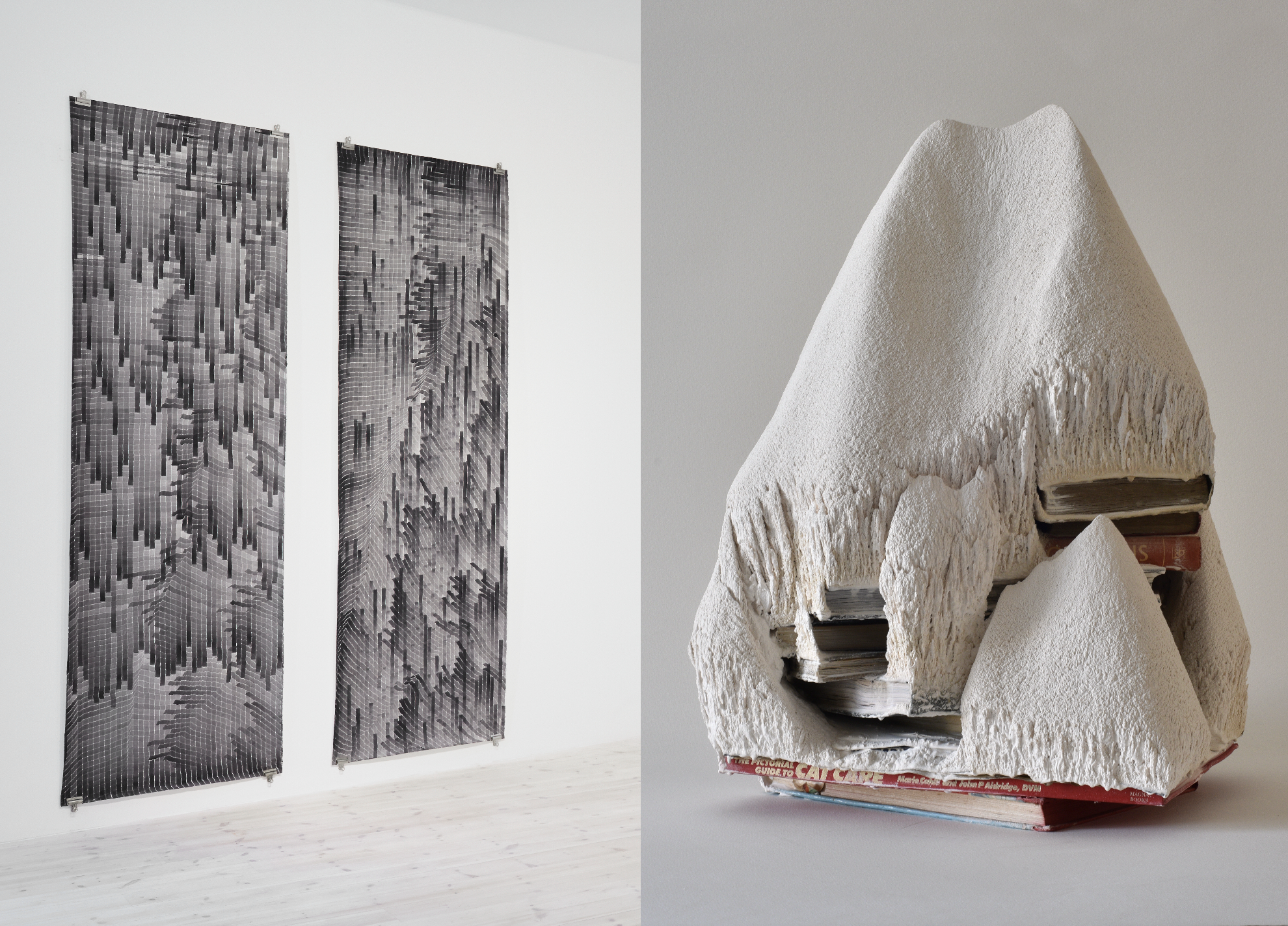
En otras partes de la exposición, la información adquiere propiedades casi geológicas. En Sheet music and the mind (2013–2020), una colección de libros —que incluye partituras y un volumen sobre la mente— se cubre con yeso tamizado. El material suelto se asienta según su «ángulo de reposo» natural antes de endurecerse formando cumbres. Callan conecta este proceso con canchales, avalanchas, deslizamientos de tierra, sedimentos y nevadas, considerando el tiempo como un material de la obra tanto como el propio yeso. El significado también se convierte en algo capaz de acumularse y endurecerse. Como escribe: «Los seres humanos somos criaturas de significado; donde no podemos encontrarlo, lo inventamos».
La información asume una estructura similarmente geológica en The Plastic Arts (2023). Las páginas extraídas de un libro sobre escultura clásica se colocan en un molde de madera bajo capas alternadas de yeso. La información queda profundamente enterrada y permanece legible solo en los márgenes expuestos, que Callan compara con los estratos de las rocas sedimentarias. La obra se enmarca en un interés recurrente por los procesos naturales —tanto biológicos como geológicos— que atraviesa su práctica.
La transformación de la información no siempre depende de la ocultación. Callan se interesa por igual en las relaciones inesperadas que emergen cuando las publicaciones se cortan, se combinan o se dejan contradecir su aparente tema central. En Great disasters in the universe (2016), por ejemplo, dos publicaciones se encuentran físicamente: Great Disasters se corta con guillotina en cinco formas orgánicas y se inserta en una segunda publicación.
Esto resulta especialmente evidente en obras recientes con resina. En European conflict around an atlas to the stars (2026), la pigmentación de los libros se vuelve integral para la apariencia de la obra. Un libro sobre Europa, impreso en papel magenta, forma su borde exterior, mientras que la publicación interior no es un atlas del cosmos, como el título podría sugerir inicialmente, sino un libro sobre estrellas de cine. El objeto circular resultante se asemeja, según la descripción de Callan, a una fruta o un planeta cortado en rodajas con un núcleo móvil. En Painting around Science (2026), publicaciones incrustadas en resina epoxi se disponen en formas amplias que Callan concibe como grandes pinceladas. Un libro sobre pintura victoriana envuelve publicaciones periódicas semanales sobre ciencia, produciendo una inversión inesperada: el material científico es el más colorido de los dos, mientras que el libro dedicado al arte es comparativamente sobrio. La obra aproxima la información impresa a la pintura, no a través de la representación, sino mediante las propiedades de color y materia contenidas en las propias publicaciones.
Bajo estas transformaciones subyace un cuestionamiento más amplio sobre el estatus que otorgamos a la información. Callan observa que «consideramos la información como algo sagrado», lo que nos perturba ante su destrucción o eliminación, al tiempo que producimos más información de la que somos capaces de absorber. Como él mismo señala: «Actualmente, el mundo produce más información de la que jamás podrá digerir. Puede que sea nuestro mayor contaminante». En A Dutch Waterfall (2020), líneas de texto que describen la colección de arte holandés de la National Gallery generan cortinas descendentes dibujadas a mano, fluyendo cada una sobre la siguiente. La información sigue siendo la fuente de la obra, pero su lenguaje se transforma en un acontecimiento visual.
A lo largo de las catorce obras de la exposición, la información nunca se trata como algo neutro o inmaterial. En un momento en que la información es generada, mediada y consumida cada vez más a través de sistemas digitales y artificiales, esta atención sostenida a su forma física resulta particularmente resonante. El lenguaje se convierte en superficie; las páginas en estratos; la notación en imagen; y la información impresa adquiere peso, color y textura.
Callan vive y trabaja en Londres y reside en su estudio de London Dockyard, en Woolwich. Estudió en el Goldsmiths College of Art antes de realizar estudios de posgrado en escultura en la Slade School of Fine Art. En 1993, fue galardonado con la beca Henry Moore Fellowship en Escultura. Ha expuesto internacionalmente, con exposiciones individuales en Londres, Nueva York, Colonia, Bruselas, Copenhague, Ginebra y Pittsburgh, entre otras ciudades. Su obra también se ha presentado en instituciones como Kettle's Yard (Cambridge), The Drawing Center (Nueva York), el Institute of Contemporary Art (Boston), la Yale University Art Gallery, el Teylers Museum (Haarlem) y la Serpentine Gallery (Londres).
La obra de Callan forma parte de importantes colecciones públicas e institucionales, como el Museum of Modern Art de Nueva York, The British Museum en Londres, The Henry Moore Institute en Leeds, la Whitworth en Mánchester, la British Council Collection, el High Museum of Art en Atlanta, el Princeton University Art Museum, el Leopold-Hoesch-Museum en Alemania, la Ferens Art Gallery en Hull y la South London Gallery.
«El mundo cambia de manera inevitable. Al mismo tiempo, los seres humanos buscamos patrones y regularidades». — Sophie Tottie
Desde la década de 1990, Sophie Tottie (n. 1964, Estocolmo) ha desarrollado una práctica conceptual centrada en los sistemas de representación, el lenguaje y las estructuras a través de las cuales se organiza y comprende la información sobre cuestiones existenciales. Al trabajar a través de la pintura, el dibujo, los objetos, la fotografía, el grabado y el vídeo, su práctica se desplaza entre los sistemas conceptuales y los procesos físicos mediante los cuales toman forma.
La línea ha sido durante mucho tiempo un elemento central en esta investigación. Tottie suele comenzar con una marca simple, un sistema definido y recurre con frecuencia a un gesto repetido, permitiendo que minúsculas variaciones producidas por el movimiento de la mano se acumulen sobre la superficie. En lugar de corregir estas irregularidades, permite que determinen lo que sigue. El orden genera desviación; la repetición produce diferencia. Este enfoque es particularmente evidente en su serie Written Language (line drawings). El Museum of Modern Art de Nueva York conserva dos obras de esta serie, Written Language (line drawings), # V y # VI (ambas de 2008), cada una con unas medidas de 216 × 113 cm. Comenzando con una línea de tinta a mano alzada en la parte superior del papel, las líneas sucesivas siguen y amplifican las pequeñas inconsistencias de las precedentes, transformando gradualmente un sistema simple en un complejo campo abstracto.
La escala de estos dibujos es integral para su creación. Tottie ha descrito el dibujo como una actividad física en la que el movimiento de la mano y del brazo, afectado por el cuerpo, su postura y su posición, deja su huella sobre el papel. Con más de dos metros de altura, las obras de Written Language sitúan las dimensiones del dibujo en relación directa con las del cuerpo. Las pequeñas desviaciones y los movimientos involuntarios no se eliminan, sino que se incorporan a la estructura en desarrollo. Cada línea responde a la anterior, de modo que un procedimiento inicialmente ordenado registra progresivamente las contingencias de su propia ejecución. El dibujo se convierte tanto en un sistema como en un registro de las imprevistas capacidades del cuerpo en relación con los sistemas de reproducción exacta.
En Oxidopolis I y II (2014), presentadas en el Ileana Tounta Contemporary Art Center de Atenas en 2018–19, esta investigación sobre la línea, la repetición y el movimiento corporal se extiende a las propiedades materiales del propio acto de inscripción. En esta obra, Tottie utiliza tinta ferrogaliciana, una tinta de escritura histórica cuyo contenido metálico se oxida al exponerse al aire, pasando de transparente a oscura. Las líneas se cruzan y se superponen, formando densos campos entretejidos en los que la acumulación de trazos reduce progresivamente la visibilidad. En Oxidopolis II, que alcanza los 3,4 metros de altura, la escala de la superficie enfatiza aún más el dibujo como una actividad espacial y física.
La elección de la tinta ferrogaliciana es significativa. Históricamente valorada por la durabilidad de los documentos escritos, aquí se comporta como un material activo: el trazo continúa cambiando mediante la oxidación justo después de ser aplicado. Por lo tanto, la realización del trazo se convierte tanto en un medio de registro como en un proceso de transformación. A medida que las líneas se acumulan y se cruzan, su capacidad para transmitir la escritura lineal se transforma progresivamente; lo que inicialmente podría sugerir escritura o un sistema de notación se convierte en densidad, textura y presencia material. En consecuencia, el tiempo está presente en estas obras en más de un sentido: se registra a través del trabajo repetido requerido para construir el dibujo, a través de la secuencia en la que una línea determina la siguiente y, en Oxidopolis, también a través de la transformación química de la propia tinta. La obra terminada no es simplemente la imagen producida por un procedimiento, sino un registro de la duración: de movimientos, desviaciones y cambios materiales acumulados sobre la superficie.
Las obras de Möbius Mesh amplían estas cuestiones al tiempo que alteran la relación entre la línea, el lenguaje y la superficie. En Möbius Mesh (Blips) y Möbius Mesh (Triple Line) (ambas de 2017), líneas repetidas forman redes densas que se mueven entre el dibujo, la escritura y el diagrama, explorando la ambigüedad del significado lingüístico fijo. Ambas obras miden 113 × 216 cm, manteniendo la escala corporal que caracteriza gran parte de la práctica del dibujo de Tottie. Pequeños desplazamientos se acumulan y alteran la estructura a medida que se desarrolla. En Möbius Mesh (Cylinder) (2017–22), la tinta china sobre papel se envuelve alrededor de un tubo de metal y se sujeta mediante imanes, llevando la línea más allá de la hoja plana hacia una forma espacial continua. De este modo, el objeto dibujado enfatiza que no es solo una imagen sobre una superficie; la propia superficie pasa a formar parte de la estructura a través de la cual se experimenta la línea.
El dibujo opera simultáneamente como imagen, inscripción, actividad física y registro: un medio para poner a prueba cómo los sistemas de representación se encuentran con las condiciones impredecibles de su existencia material.
A lo largo de una práctica que abarca más de tres décadas, Tottie ha regresado a una pregunta fundamental: ¿cómo se sostienen los sistemas que utilizamos para describir, organizar y dar sentido al mundo cuando se encuentran con el propio mundo físico? Su trabajo recurre a estructuras asociadas con el orden y la comunicación —la escritura, los diagramas, los mapas, la medición y la línea— al tiempo que revela la facilidad con la que su aparente certeza puede desplazarse. Un gesto repetido genera diferencia; una inscripción se vuelve lenta de leer; un material continúa transformándose; una estructura destinada a aclarar puede acumularse hasta convertirse en complejidad. Para Tottie, estos no son fallos de un sistema, sino momentos en los que sus complejas condiciones se hacen visibles. Desde sus primeras obras hasta el presente, su práctica ha ocupado el espacio entre nuestro deseo de imponer orden en el mundo y la complejidad que continuamente lo desborda. Sophie Tottie vive y trabaja en Estocolmo.
The Unreadable World (El mundo ilegible) aproxima estas prácticas diferenciadas sin anular sus diferencias. Callan comienza con información ya codificada —libros, mapas, fotografías y partituras musicales— y la somete a una transformación física; Tottie suele comenzar con el acto mismo de la inscripción, permitiendo que el trazo directo, el movimiento y el cambio material exploren los sistemas que ella establece. En ambos, la legibilidad nunca se pierde simplemente. En su lugar, su alteración produce otro tipo de conocimiento: uno portado por la superficie, el peso, el ritmo, la densidad, la duración y la forma. La exposición propone que nuestra experiencia del mundo no cobra sentido únicamente a través de los sistemas, sino también a través de todo lo que escapa a ellos.
Tottie estudió en la Real Academia de Arte de Estocolmo (1986–91) y en el Institut des hautes études en arts plastiques de París (1989–90). Su obra se ha mostrado internacionalmente desde principios de la década de 1990, incluyendo On Line: Drawing Through the Twentieth Century en el Museum of Modern Art de Nueva York (2010); Mirror’s Edge, comisariada por Okwui Enwezor (1999–2001); Visions du Nord / Nuit Blanche en el Musée d’Art Moderne de la Ville de Paris (1998); y Deposition en la 47.ª Bienal de Venecia (1997). Ha presentado exposiciones individuales en instituciones como el Museum of Contemporary Art de Chicago, el Göteborgs Konstmuseum, el Lunds Konsthall, el Malmö Konstmuseum y la Konstakademien de Estocolmo. Junto a su práctica de taller, Tottie fue profesora de Bellas Artes en la Malmö Art Academy de la Universidad de Lund (2001–09), artista e investigadora invitada en la Universidad de Harvard (2009–10) y profesora de Bellas Artes en la Real Academia de Arte de Estocolmo (2012–22). En 2026, fue galardonada con el Premio Paul Hedqvist por la Konstakademien.
La obra de Tottie forma parte de importantes colecciones públicas e institucionales, entre ellas el Museum of Modern Art (MoMA) de Nueva York, el Moderna Museet de Estocolmo y la Schering Stiftung Collection en el Kupferstichkabinett de los Staatliche Museen zu Berlin.
ENGLISH
Richeldis Fine Art BCN presents an exhibition of British artist Jonathan Callan and Swedish artist Sophie Tottie. Tottie and Callan meet at the point where information loses its certainty and becomes visual and material form.
Across drawing, painting, sculpture and material intervention, both artists explore how systems of meaning are transformed through material form. For more than three decades, Jonathan Callan (b. 1961, Manchester) has developed a practice centred on the physical life of information and the different languages through which we or-giasen and understand experience. Working with books, maps, musical scores, photographs and oth-er printed matter, he approaches these materials not simply as carriers of meaning, but as objects with their own weight, structure and resistance. Books and pages are cut, drawn over, layered, buried, compressed or embedded in plaster, silicone and resin. Callan has described coming to regard books much as a potter regards clay: as material to be handled, tested and transformed. As he writes, “How we reduce our experiences of the world to different languages plays an incredibly significant role in how we then understand it.”
His interventions unsettle the expectation that printed information should remain stable or that an artist’s treatment of a text should necessarily illustrate its content. Instead, words can become image, pages become strata and familiar systems of communication can be made strange or newly visible.
This exhibition brings together fourteen works spanning more than two decades, from 2004 to works made in 2026. Across this period, Callan’s methods and materials continually change while the underlying enquiry persists. Printed matter is drawn over, cut apart, combined, con-cealed or embedded; plaster, silicone and resin introduce different physical conditions. Individual works can appear markedly distinct from one another, yet remain connected by questions of how information is constructed, communicated and understood.
Musical notation forms one thread running through the exhibition. Callan’s attraction to it began long before his hearing deteriorated and, as he explains, sprang from the same interest that drew him to books, maps, and other modes of information. In Gigue, relative too (2004), a point is isolated on the page and every note is drawn towards it, creating what Callan describes as a new perspective both visually and musically. Years later, musical notation acquired a more personal significance through Callan’s progressive hearing loss. In two works whose titles incor-porate their original page references, Things I’ll never hear, p.29 and Things I’ll never hear p.257 (both 2022), the conventions of the musical score are altered in different ways. In Things I’ll never hear, p.29, each note is replaced by a circle that gradually increases in size down the page, an image Callan likens to an improbable snowstorm in which the flakes become larger as they approach the earth. Although Callan does not read musical notation, he deliberately respects the accuracy of its printed format while introducing changes that might initially appear authentic, giving the score what he calls a “surreal dimension.”
In Things I’ll never hear. Parsifal. P.112, this transformation becomes increasingly materi-al. Callan covers each note in black, adds a colour close to that of the blank paper and applies slow-setting epoxy resin. As the resin moves across the page, the pigments fuse and bleed into one another. Here the altered score is connected directly to Callan’s experience of progressive-ly losing frequencies: he describes sound becoming “a soup of compressed noise” in which space disappears.
Elsewhere in the exhibition, information takes on almost geological properties. In Sheet music and the mind (2013–2020), a collection of books, including sheet music and a volume on the mind, is covered with sieved plaster. The loose material settles according to its natural “angle of repose” before hardening into peaks. Callan connects this process to scree, avalanch-es, landslides, sediment and snowfall, considering time as much a material in the work as the plaster itself. Meaning, too, becomes something capable of accumulating and hardening. As he writes, “Humans are creatures of meaning, Where we can’t find it we invent it.”
Information assumes a similarly geological structure in The Plastic Arts (2023). Pages removed from a book on classical sculpture are placed in a wooden mould beneath alter-nating layers of plaster. Information becomes deeply buried, remaining legible only at the exposed margins, which Callan compares to strata in sedimentary rock. The work belongs to a recurring interest in natural processes - both biological and geological - that runs through his practice.
The transformation of information does not always depend upon concealment. Callan is equally interested in the unexpected relationships that emerge when publications are cut apart, combined or allowed to contradict their apparent subject matter. In Great disasters in the universe (2016), for example, two publications meet physically: Great Disasters is guillo-tine-cut into five organic forms and inserted into a second publication.
This is particularly apparent in recent works in resin. In European conflict around an atlas to the stars (2026), the pigmentation of the books becomes integral to the work’s appearance. A book on Europe, printed on magenta paper, forms its outer edge, while the inner publica-tion is not an atlas of the cosmos, as the title might initially suggest, but a book on film stars. The resulting circular object resembles, in Callan’s description, a sliced fruit or planet with a mobile core. In Painting around Science (2026), publications embedded in epoxy resin are arranged in broad forms that Callan thinks of as large brushstrokes. A book on Victorian painting encloses weekly periodicals on science, producing an unexpected reversal: the scientif-ic material is the more colourful of the two, while the book concerned with art is comparatively subdued. The work brings printed information towards painting, not through representation but through the colour and material properties already contained within the publications themselves.
Underlying these transformations is a wider questioning of the status we give to information. Callan observes that “We regard information as a sacred thing”, becoming distressed by its destruction or removal while at the same time producing more information than we are capable of absorbing. As he puts it“, the world currently produces more information than it can ever digest. It may be our biggest pollutant.” In A Dutch Waterfall (2020), lines of text describing the National Gallery’s collection of Dutch art generate hand-drawn descending c-utrains, each flowing over the next. Information remains the source of the work, but its language is transformed into a visual event.
Across the fourteen works in the exhibition, information is never treated as neutral or immateri-al. At a moment when information is increasingly generated, mediated and consumed through digital and artificial systems, this sustained attention to its physical form feels particularly reso-nant. Language becomes surface; pages become strata; notation becomes image; and printed information acquires weight, colour and texture.
Callan lives and works in London and is based at his studio at the London Dockyard in Woolwich. He studied at Goldsmiths College of Art before completing postgraduate studies in sculpture at the Slade School of Fine Art. In 1993, he was awarded a Henry Moore Fellowship in Sculpture. He has exhibited internationally, with solo exhibitions in London, New York, Cologne, Brussels, Copenhagen, Geneva and Pittsburgh, among others. His work has also been presented at institutions including Kettle’s Yard, Cam-bridge; The Drawing Center, New York; the Institute of Contemporary Art, Boston; Yale University Art Gallery; Teylers Museum, Haarlem; and the Serpentine Gallery, London.
Callan’s work is held in major public and institutional collections including The Museum of Modern Art, New York; The British Museum, London; The Henry Moore Institute, Leeds; the Whitworth, Manchester; the British Council Collection; High Museum of Art, Atlanta; Princeton University Art Museum; Leopold-Hoesch-Museum, Germany; Ferens Art Gallery, Hull; and South London Gallery.
“The world is always inevitably changing. At the same time, we humans look for pat-terns and regularities.” — Sophie Tottie
Since the 1990s, Sophie Tottie (b. 1964, Stockholm) has developed a conceptual practice concerned with systems of representation, language, and the structures through which informa-tion about existential questions is organised and understood. Working across painting, drawing, objects, photography, prints and video, her practice moves between conceptual systems and the physical processes through which they take form.
The line has long been central to this investigation. Tottie often begins with a simple mark, a defined system and often uses a repeated gesture, allowing minute variations produced by the movement of the hand to accumulate across the surface. Rather than correcting these irregularities, she allows them to determine what follows. Order generates deviation; repetition produces difference. This approach is particularly evident in her Written Language (line drawings) series. The Museum of Modern Art, New York, holds two works from the series, Written Language (line drawings), # V and # VI (both 2008), each measuring 216 × 113 cm. Beginning with a freehand line of ink at the top of the paper, successive lines follow and amplify the small inconsistencies of those preceding them, gradually transforming a simple system into a complex abstract field.
The scale of these drawings is integral to their making. Tottie has described drawing as a physical activity in which the movement of the hand and arm, affected by the body, its posture and position, leaves its trace on the paper. At more than two metres high, the Written Language works bring the dimensions of the drawing into direct relation with those of the body. Small deviations and involuntary movements are not eliminated but incorporated into the developing structure. Each line responds to the one before it, so that an initially ordered procedure progressively records the contingencies of its own execution. The drawing becomes both a system and a record of the body’s unpredictable abilities in relation to systems that reproduce exactly.
In Oxidopolis I and II (2014),presented at the Ileana Tounta Contemporary Art Center, Ath-ens, in 2018–19, this investigation of line, repetition and bodily movement extends into the ma-terial properties of inscription itself. In this work Tottie uses iron gall ink, a historic writing ink whose metal content oxidises through exposure to air, moving from transparent towards dark. Lines cross and overlay one another, forming dense woven fields in which the accumulation of marks progressively reduces visibility. In Oxidopolis II, which extends to 3.4 metres in height, the scale of the surface further emphasises drawing as a spatial and physical activity.
The choice of iron gall ink is significant. Historically valued for the durability of written documents, here it behaves as an active material: the mark continues to change through oxidation just after it has been applied. Mark making therefore becomes both a means of recording and a process of transformation. As lines accumulate and cross one another, their capacity to transmit linear scripture is progressively transformed; what might initially suggest writing or a system of notation becomes density, texture and material presence. Time is consequently present in these works in more than one sense. It is registered through the repeated labour required to construct the drawing, through the sequence in which one line determines the next and, in Oxidopolis, also through the chemical transformation of the ink itself. The finished work is not simply the image produced by a procedure but a record of duration: of movements, deviations and material changes accumulated across the surface.
The Möbius Mesh works extend these questions while altering the relationship between line, language and surface. In Möbius Mesh (Blips) and Möbius Mesh (Triple Line) (both 2017), epeated lines form dense networks that move between drawing, writing and diagram which explore the ambiguity of fixed linguistic meaning. Both works measure 113 × 216 cm, retaining the bodily scale that characterises much of Tottie’s drawing practice. Small shifts accumulate and alter the structure as it develops. In Möbius Mesh (Cylinder) (2017–22), Indian ink on paper is wrapped around a metal tube and held by magnets, taking the line beyond the flat sheet and into a continuous spatial form. In this way the drawing object emphasizes how it is not only an image on a surface; the surface itself becomes part of the structure through which the line is experienced.
Drawing operates simultaneously as image, inscription, physical activity and record - a means of testing how systems of representation encounter the unpredictable conditions of their material existence.
Across a practice spanning more than three decades, Tottie has returned to a fundamental question: how do the systems we use to describe, organise and make sense of the world hold up when they encounter the physical world itself ? Her work draws on structures associated with order and communication - writing, diagrams, maps, measurement and the line - while revealing how readily their apparent certainty can shift. A repeated gesture generates difference; an inscription becomes slow to read; a material continues to transform; a structure intended to clarify can accumulate into complexity. For Tottie, these are not failures of a system but moments in which its complex conditions become visible. From her earliest works to the present, her practice has occupied the space between our desire to impose order on the world and the complexity that continually exceeds it. Sophie Tottie lives and works in Stockholm.
The Unreadable World brings these distinct practices into proximity without col-lapsing their differences. Callan begins with information already encoded — books, maps, photographs and musical scores — and subjects it to physical transforma-tion; Tottie often begins with the act of inscription itself, allowing direct mark making, movement and material change to explore the systems she establishes. In both, legibility is never simply lost. Instead, its disruption produces another kind of knowledge: one carried by surface, weight, rhythm, density, duration and form. The exhibition proposes that our experience of the world is not made meaningful by systems alone, but also by everything that escapes them.
Tottie studied at the Royal Institute of Art in Stockholm (1986–91) and the Institut des hautes études en arts plastiques in Paris (1989–90). Her work has been shown inter-nationally since the early 1990s, including On Line: Drawing Through the Twentieth Century at The Museum of Modern Art, New York (2010); Mirror’s Edge, curated by Okwui Enwezor (1999– 2001); Visions du Nord / Nuit Blanche at Musée d’Art Moderne de la Ville de Paris (1998); and Deposition at the 47th Venice Biennale (1997). She has presented solo exhibitions at institutions including the Museum of Contemporary Art Chicago, Göteborgs Konstmuseum, Lunds Konsthall, Malmö Konstmuseum and Kons-takademien, Stockholm. Alongside her studio practice, Tottie was Professor of Fine Art at Malmö Art Academy, Lund University (2001–09), Visiting Artist/ Lecturer at Harvard University (2009–10), and Professor of Fine Art at the Royal Institute of Art, Stockholm (2012–22). In 2026, she was awarded the Paul Hedqvist Award by Konstakademien.
Tottie’s work is held in major public and institutional collections including The Muse-um of Modern Art (MoMA), New York; Moderna Museet, Stockholm; and the Schering Stiftung Collection at the Kupferstichkabinett, Staatliche Museen zu Berlin.